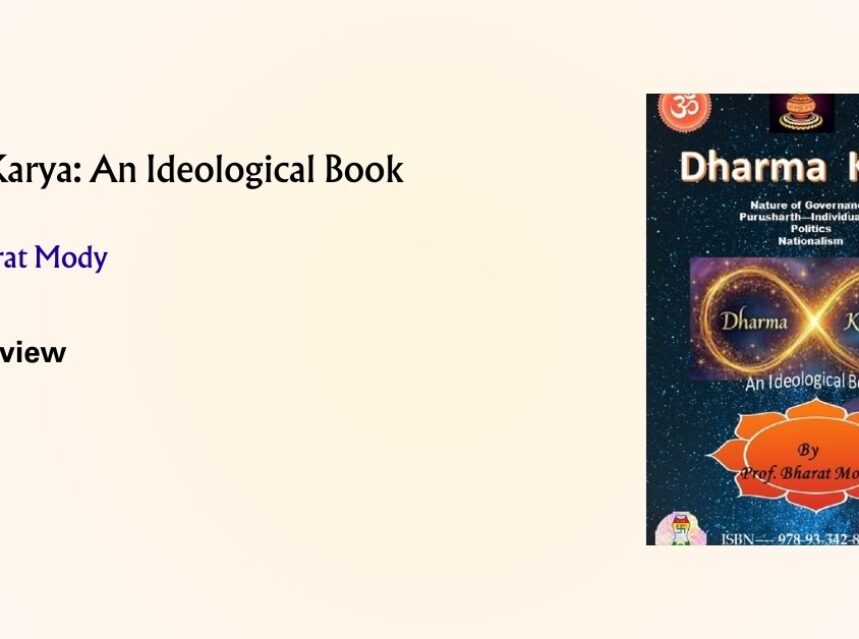
Dharma Karya, An Ideological Book by Prof Bharat M Mody: Review
 By
By Prof. Bharat M. Mody’s DHARMA KARYA: An Ideological Book is a powerful and inspiring work for readers seeking to reconnect with the philosophical, cultural, and intellectual legacy of ancient India. Rather than approaching Sanatan Dharma through ritual or religious sentiment, the author frames it as a complete civilisational wisdom system that once shaped the world’s most enduring society. The tone of the book is assertive and confident, inviting readers to rediscover a heritage that is not only spiritually rich but philosophically sophisticated and deeply relevant to the modern age. Through this approach, the book offers a positive and energising experience for those seeking clarity about India’s cultural roots and civilisational identity.
A significant strength of the work is its insistence that Sanatan Dharma is not simply a religion but a way of life shaped by rational inquiry, philosophical depth, artistic excellence, and an abiding respect for nature. The author’s descriptions of Dharma as scientific, culture-centred, and grounded in the pursuit of knowledge allow readers to view ancient India not as a land defined by superstition but as one guided by intellectual courage and moral purpose. This perspective helps modern readers appreciate that India’s civilisational achievements were not accidental. They were the result of a consistent worldview that encouraged exploration, debate, self-realisation, and respect for diversity. By making these ideas accessible, the book becomes a tool for rediscovering India’s intellectual greatness.
Prof. Mody’s treatment of Purusharth is significant for those interested in both personal growth and cultural knowledge. The way he presents Dharma, Artha, Kama, and Moksha highlights a harmonious vision of life that neither rejects material success nor isolates spiritual aspiration from daily living. This fourfold philosophy shows readers that ancient India pursued balance rather than renunciation alone. It reassures contemporary audiences that one can aspire, create, and enjoy while remaining ethical and spiritually aligned. Many readers will find this model a refreshing alternative to rigid moral systems and will see how ancient Indian philosophy offers guidance for living a balanced, purposeful modern life.
The book also shows how ancient Indian thought once shaped social structures that valued wisdom, independence, and responsibility. The author discusses the Gurukul education system as a model that encouraged holistic growth, respect for teachers, and close contact with nature. When modern readers encounter these descriptions, they are reminded of an era in which education aimed to shape character and intellect rather than produce workers for an economic machine. This perspective encourages readers to reflect on present shortcomings in education and to appreciate the holistic vision that ancient India once championed. Through this, the book fosters admiration and pride in India’s educational heritage.
Another appealing element of DHARMA KARYA is its account of how ancient India perceived health and well-being. The author describes Ayurveda not as an alternative or outdated practice but as a sophisticated system built on observation, balance, and personalised care. Readers looking for deeper cultural connections will find value in understanding how this tradition viewed health as a harmony among body, mind, and environment. This reconnects them with a worldview that cares for nature, respects individuality, and emphasises long-term wellbeing. Many will see in Ayurveda’s principles a way to live more consciously in a world overwhelmed by stress and artificial lifestyles.
Prof. Mody’s optimistic vision of Sanatan Dharma also extends to governance and community life. Although the book contains strong critiques of contemporary systems, its uplifting contribution lies in demonstrating how ancient Indian ideals once promoted fairness, self-governance, and trust between rulers and citizens. Concepts like Ram Rajya, which the author describes as a state of justice, dignity, and mutual respect, help readers imagine a society guided by ethical leadership and sincere public welfare. This is especially inspiring for those who feel disconnected from today’s political climate. The book revives the idea that governance can be rooted in values and that India has its own indigenous models of just and moral administration.
Throughout the book, the author presents Sanatan Dharma as a source of confidence rather than nostalgia. His admiration for India’s civilisational continuity encourages readers to reconsider the depth and richness of their heritage. He highlights how Indian civilisation survived centuries of adversity by being anchored in strong philosophical foundations, cultural adaptability, and respect for knowledge. This narrative instils pride and reminds readers that India’s past is not merely a tale of conquest and struggle but one of endurance and wisdom. For readers who feel detached from their cultural identity, this perspective offers encouragement and a renewed sense of belonging.
What makes DHARMA KARYA particularly effective as a positive cultural guide is its ability to translate ancient philosophical ideas into meaningful reflections for the present. The author consistently argues that ancient Indian principles remain relevant for modern challenges. Whether discussing education, healthcare, social harmony, or personal development, he demonstrates how traditional knowledge systems can help individuals cultivate clarity and resilience. Readers who approach the book with openness are likely to walk away with a deeper appreciation of how ancient Indian wisdom can offer solutions to contemporary dilemmas.
The book’s tone, although strong, is fundamentally empowering. It challenges readers to take pride in their heritage, to study their civilisational roots, and to engage with India’s ancient philosophy not as an artefact but as a living guide. In doing so, DHARMA KARYA helps readers reconnect with the greatness of ancient India in a way that feels meaningful and practical. It encourages them to view their culture not with passive admiration but with active curiosity and renewed confidence.
Overall, Prof. Bharat M. Mody’s work stands out as a passionate tribute to India’s civilisational wealth. It inspires readers to reclaim knowledge systems that have shaped Indian identity for thousands of years. For anyone seeking a positive, pride-affirming, and intellectually stimulating engagement with ancient Indian thought, DHARMA KARYA is a compelling resource that deepens cultural understanding and strengthens connection to Bharat’s timeless heritage.
Get a copy from Amazon India – click here.
Review by Jyotsna for The Book Blog
