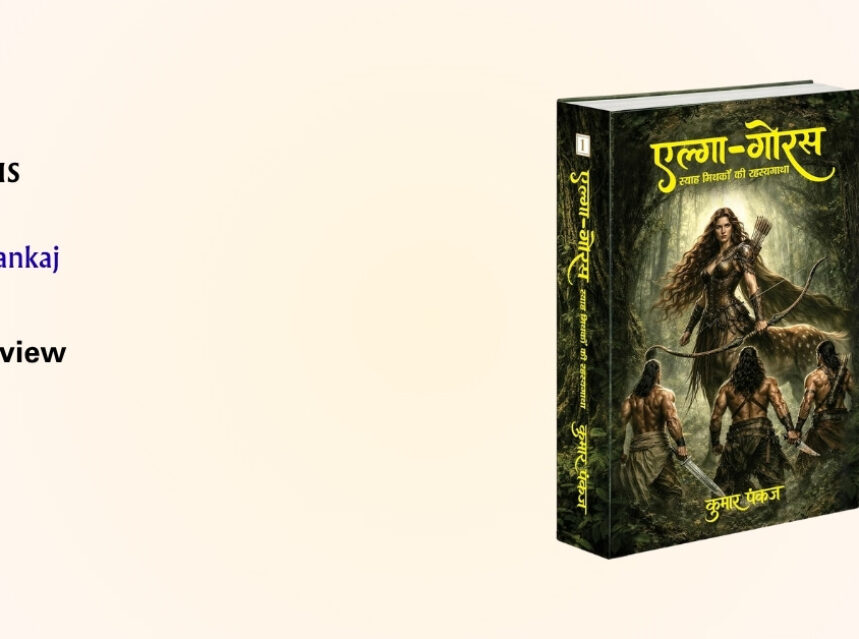
Elga Gorus by Kumar Pankaj – Review of the Fantasy Novel in Hindi
 By
By Having read a fair number of English fantasy novels over the years, ranging from medieval quest fantasies to dark mythological epics and contemporary speculative fiction, I approached Kumar Pankaj’s Elga Gorus with both curiosity and caution. Fantasy readers often develop certain expectations from the genre. We expect elaborate world-building, mysterious lore, memorable characters, hidden histories, magical systems, and a sense of wonder. Western fantasy literature has excelled in these areas for decades, producing worlds that have become cultural landmarks. What I did not expect from Elga Gorus was how effectively it would meet those expectations while also offering something that many English-language fantasy novels cannot provide for Indian readers: a sense of cultural familiarity and emotional proximity. By the time I completed both volumes, I realised that Kumar Pankaj had achieved something genuinely noteworthy. He had not merely written a fantasy novel. He had created a fantasy experience that feels inherently connected to the Indian imagination.
One of the most obvious differences between Elga Gorus and much of Western fantasy literature lies in its mythology. Many English fantasy novels create worlds inspired by European folklore, medieval kingdoms, Nordic legends, or invented cosmologies that often feel culturally distant to Indian readers. They are fascinating, certainly, but they remain foreign landscapes. Elga Gorus feels different from the very beginning. Its mysteries, its atmosphere, its narrative rhythm, and even its imagination seem to emerge from a sensibility closer to the Indian storytelling tradition. There are ancient texts, hidden knowledge systems, strange races, mysterious wanderers, forgotten histories, and sacred quests, but these elements never feel borrowed or transplanted. Instead, they feel organically connected to a cultural imagination that Indian readers instinctively understand. The novel possesses the spirit of myth rather than the mechanics of fantasy alone.
What impressed me most across both volumes was Kumar Pankaj’s ability to create a vast fantasy universe without losing sight of emotional accessibility. One criticism often directed at large-scale fantasy novels is that they become so absorbed in their mythology that readers struggle to connect with the characters. In Elga Gorus, however, the characters remain central to the experience. Despite the presence of mysterious creatures, ancient powers, magical realms, and strange civilisations, the story’s emotional motivations remain deeply human. Fear, curiosity, loyalty, sacrifice, ambition, hope, and uncertainty are universal experiences. Kumar Pankaj understands this well. His characters may inhabit extraordinary circumstances, but their emotional journeys remain relatable. This is one of the reasons the novel succeeds so effectively. Readers are not merely observing an imaginative world. They are emotionally participating in it.
The richness of the world-building deserves particular praise. Fantasy readers often evaluate novels based on the credibility and depth of their fictional universes, and Elga Gorus performs remarkably well in this regard. The two volumes introduce readers to a landscape populated by ancient books, mysterious scripts, hidden settlements, dangerous territories, bizarre creatures, forgotten histories, and mythological forces operating beneath visible reality. Yet the novel never feels like an encyclopedia of fantasy concepts. Every location serves a narrative purpose. Every mystery contributes to a larger atmosphere of discovery. Every revelation deepens the reader’s investment in the world. Kumar Pankaj demonstrates an impressive understanding of how mystery should function within fantasy. Answers are never provided too quickly. New discoveries frequently generate new questions. This continual process of revelation and concealment keeps readers engaged throughout both volumes.
Another aspect that distinguishes Elga Gorus from many Western fantasy novels is its treatment of atmosphere. Western fantasy often relies heavily on political conflict, military campaigns, dynastic struggles, or large-scale warfare. While such elements can certainly be compelling, they are not the primary focus here. The dominant atmosphere of Elga Gorus is one of mystery, wonder, and exploration. Readers move through caves, deserts, forests, forgotten realms, and strange settlements with a constant sense of uncertainty. The world feels ancient, layered, and partially hidden. There is always the suggestion that some deeper truth lies just beyond the reader’s current understanding. This quality gives the novel a distinctly mythological texture. It often feels closer to a dark legend or a forgotten epic than to conventional modern fantasy fiction.
The visual quality of Kumar Pankaj’s writing also deserves recognition. One of the great pleasures of reading fantasy literature is the opportunity to inhabit worlds that exist nowhere else. For this experience to succeed, the writer must possess the ability to translate imagination into imagery. Elga Gorus excels in this area. The descriptions are vivid, detailed, and frequently cinematic. Mysterious landscapes, ancient structures, strange creatures, and dramatic confrontations are rendered with remarkable clarity. Several passages create images that remain in the mind long after the reading experience ends. This visual richness significantly enhances the immersive quality of the novel. Readers do not simply read about the world. They see it.
The second volume deserves special appreciation because it accomplishes something many sequels fail to achieve. Rather than merely extending the story, it deepens and enriches the experience established in the first volume. The mythology expands, the stakes increase, and the mysteries become more compelling. Many fantasy series struggle to maintain momentum after a strong beginning. Elga Gorus moves in the opposite direction. The second volume benefits from the foundation laid earlier and often feels even more engaging because readers have already developed emotional connections with the characters and the world. The result is a narrative that grows stronger as it progresses. By the end of the second volume, readers feel as though they have completed a substantial literary journey rather than simply finished a story.
Perhaps the most important contribution of Elga Gorus lies in what it represents for contemporary Hindi literature. For years, many young Indian readers interested in fantasy have looked primarily toward English-language fiction. This is understandable. The global publishing industry has produced numerous fantasy classics, and their influence is undeniable. However, there has long been a need for ambitious fantasy literature written within the framework of Indian cultural imagination. Kumar Pankaj addresses this need directly. He demonstrates that Hindi literature can support expansive world-building, complex mythology, large casts of characters, and immersive fantasy storytelling without sacrificing its cultural identity. More importantly, he proves that fantasy need not feel foreign to feel grand.
This achievement may ultimately be the novel’s greatest strength. Elga Gorus offers Indian readers the pleasure of fantasy without requiring them to leave behind their own cultural instincts. Its mysteries feel familiar even when they are strange. Its characters feel accessible even when they inhabit extraordinary circumstances. Its mythology feels imaginative without feeling imported. In many ways, Kumar Pankaj succeeds where some Western fantasy writers cannot, not because his imagination is necessarily larger, but because his imagination speaks directly to the cultural experiences and narrative expectations of Indian readers.
By the time I completed both volumes, I was left with the impression that Elga Gorus is not merely an entertaining fantasy saga but a significant literary experiment. It combines the spirit of Hindi tilism, the scale of epic fantasy, the intrigue of mystery fiction, and the emotional accessibility of character-driven storytelling. It reminds readers that fantasy literature can be both imaginative and culturally rooted. Kumar Pankaj deserves considerable appreciation for undertaking such an ambitious project and executing it with conviction. For readers who enjoy fantasy and have long wished for a large-scale Hindi work capable of standing confidently alongside international genre fiction while retaining its own identity, Elga Gorus is likely to be a rewarding and memorable experience.
Get a copy of this novel from Amazon India – click here.
Review by Nishant for The Book Blog
Elga Gorus by Kumar Pankaj – Review of the Fantasy Novel in Hindi
-
The Book Blog Critical Rating
Summary
A compelling myth-making that will keep Indian readers of Hindi fiction on their toes… till the very end of both volumes! Kumar Pankaj deserves the credit for this amazingly woven fantasy fiction.
